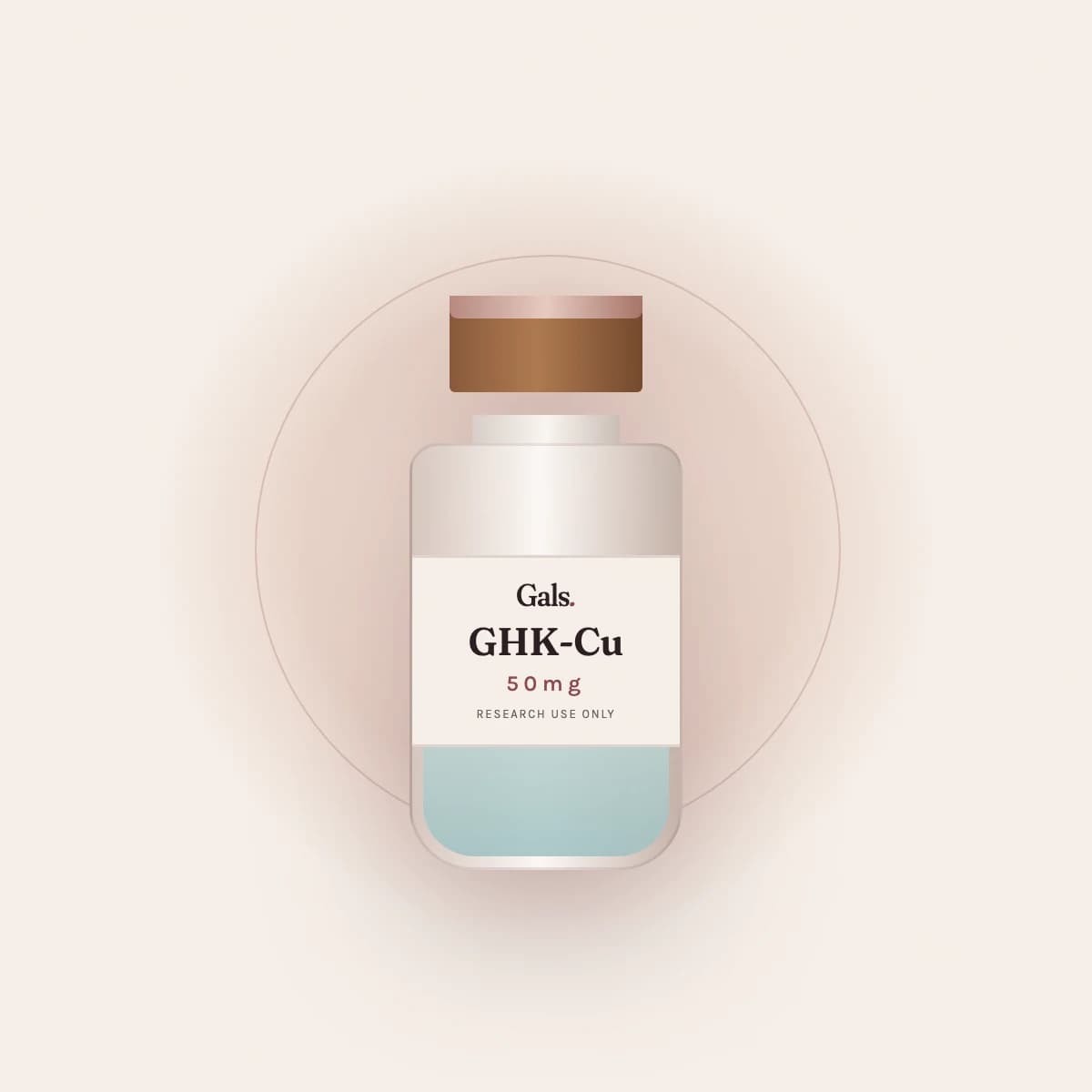
HPLC 99.72%
GHK-Cu
4.8(14 reviews)Research-grade · For in-vitro research use only
99.72%HPLC
purity
purity
In stockOrder before 12pm AEST for same-day dispatch
Bundle & save— save up to 30%
1
Pay by bank transfer or PayID · we never see or store your banking login
All prices in AUD, inclusive of GST. Shipping calculated at checkout — free express on orders over $300.
- Third-party COA — Independent HPLC + LC-MS for this product
- Express dispatch in 24h — Tracked express post from our Australian facility
- Protective packaging — Plain, protective outer packaging on every order
- Free express shipping — On orders over $300
1
A copper-binding tripeptide complex studied in laboratory research. Supplied as a lyophilised powder for in-vitro research use only, with an independent HPLC Certificate of Analysis per batch.
Copper-peptide & matrix-signalling research
GHK-Cu is a copper-binding tripeptide complex: the sequence glycyl-L-histidyl-L-lysine (GHK) coordinated to a copper(II) ion. Unlike most research peptides, which are studied as the peptide alone, GHK is studied as a metal complex — the imidazole nitrogen of the histidine residue, the terminal amine of the glycine, and the intervening amide nitrogen together form the coordination site that holds Cu(II). That geometry is the compound; the free peptide and the copper-loaded complex are treated as distinct species in the literature and are not interchangeable in an experimental design.
The tripeptide was first isolated from human plasma fractions in the 1970s during work on factors that differed between plasma from younger and older donors, and the copper-binding behaviour was characterised shortly afterwards. That origin — an endogenous sequence identified by fractionation rather than a designed analogue — is why GHK-Cu is usually described in reviews as a naturally occurring copper carrier rather than as a synthetic mimetic, and why much of the primary literature concerns copper coordination chemistry as much as peptide biology.
Research interest centres on copper-transport and copper-handling pathways, and on extracellular-matrix biology. GHK-Cu appears in in-vitro studies examining copper exchange with albumin and other plasma copper-binding proteins, in fibroblast culture models where matrix protein and matrix-metalloproteinase gene expression are read out, and in transcriptomic screens that profile broad expression changes in cultured cells. Reported observations in these areas belong to the primary studies that generated them; they are not use, safety, or outcome claims made by Gals.
Analytical characterisation matters in a specific way for a metal complex. HPLC establishes peptide purity and the absence of related sequence impurities, while identity confirmation by mass spectrometry reflects the copper-bound species, whose isotope pattern differs from the free peptide because of the natural 63Cu/65Cu distribution. Copper stoichiometry and residual free copper are the variables most likely to confound a matrix-signalling experiment, so batch-level characterisation data — rather than nominal labelling — is the reasonable basis for evaluating material intended for reproducible work.
Within the copper-peptide class, GHK-Cu is the reference point against which other copper-coordinating sequences are compared, and it is the compound most often used to define what a "copper peptide" means in a methods section. It sits apart from the synthetic sequences elsewhere in this catalogue: it is a three-residue endogenous fragment rather than an engineered analogue such as melanotan 2, and its research questions are coordination-chemistry and matrix questions rather than receptor-agonism questions.
Research areas GHK-Cu is studied in
- Copper(II) coordination chemistry and copper-exchange behaviour with plasma copper-binding proteins in vitro
- Extracellular-matrix research models, including matrix protein and matrix-metalloproteinase expression in fibroblast culture
- Transcriptomic and gene-expression profiling studies in cultured cell systems
- Comparative characterisation of copper-loaded versus free (apo) tripeptide as distinct experimental species
- Structure–activity work across GHK analogues and other copper-coordinating short sequences
- Stability and speciation research on peptide–metal complexes in aqueous buffer
Handling and reconstitution
Supplied as a lyophilised powder, typically blue to blue-violet in appearance from the coordinated copper(II). Reconstitute with bacteriostatic or sterile water, adding solvent gently down the vial wall and swirling rather than shaking; copper complexes are sensitive to chelating buffers and to pH shifts, so the choice of diluent can alter speciation in solution. Protect the reconstituted solution from light and store it cold, and keep the unreconstituted powder sealed at -20°C away from moisture, as the lyophilised complex is hygroscopic.
Product highlights
- Purity
- ≥ 99% (HPLC)
- Appearance
- White to off-white lyophilised powder
- Solubility
- Soluble in bacteriostatic / sterile water
- Testing
- Independent third-party HPLC + LC-MS
- Storage
- Store lyophilised at -20°C, protected from light
- Intended use
- In-vitro laboratory research only
Read the GHK-Cu research overview →
For laboratory research use only. Not for human or veterinary use, consumption, or therapeutic application.
Questions
GHK-Cu — frequently asked questions
What is GHK-Cu?
GHK-Cu is a copper-binding tripeptide complex (CAS 49557-75-7): the sequence glycyl-L-histidyl-L-lysine coordinated to a copper(II) ion. It is studied as a metal complex rather than as the peptide alone — the free peptide and the copper-loaded complex are treated as distinct species in the literature and are not interchangeable experimentally. Supplied lyophilised for in-vitro research use only.
Is GHK-Cu legal in Australia?
GHK-Cu is supplied here as a laboratory research chemical for in-vitro use only, not as an approved therapeutic good and not for human or veterinary use. This is not legal advice; confirming that a given laboratory use complies with the applicable Commonwealth, state, and institutional rules is the researcher’s responsibility.
Why is GHK-Cu blue?
The blue to blue-violet colour of the lyophilised powder comes from the coordinated copper(II) ion. It is a visual consequence of the metal complex rather than an indicator of purity or concentration — colour alone is not a substitute for the batch Certificate of Analysis.
What should a GHK-Cu Certificate of Analysis show?
Before you order
Research guides for GHK-Cu
Background reading for researchers — what this compound is, how it is positioned, and how to verify what is in the vial.
Compound profileGHK-Cu research monographStructure, CAS, sequence, purity and the research areas GHK-Cu is studied in.View profile →Compound guide
GHK-Cu in Australia: A Research Overview
What GHK-Cu (the copper tripeptide) is, why it is studied, and what to look for when sourcing it in Australia.
Read →HandlingHow to Read a Peptide Certificate of Analysis (COA)
A short guide to what a Certificate of Analysis actually tells you — and what to check before you trust a vial.
Read →Buying guideHow to Choose a Research Peptide Supplier in Australia
The checklist serious researchers use to separate a credible research supplier from a storefront — COA transparency above all.
Read →