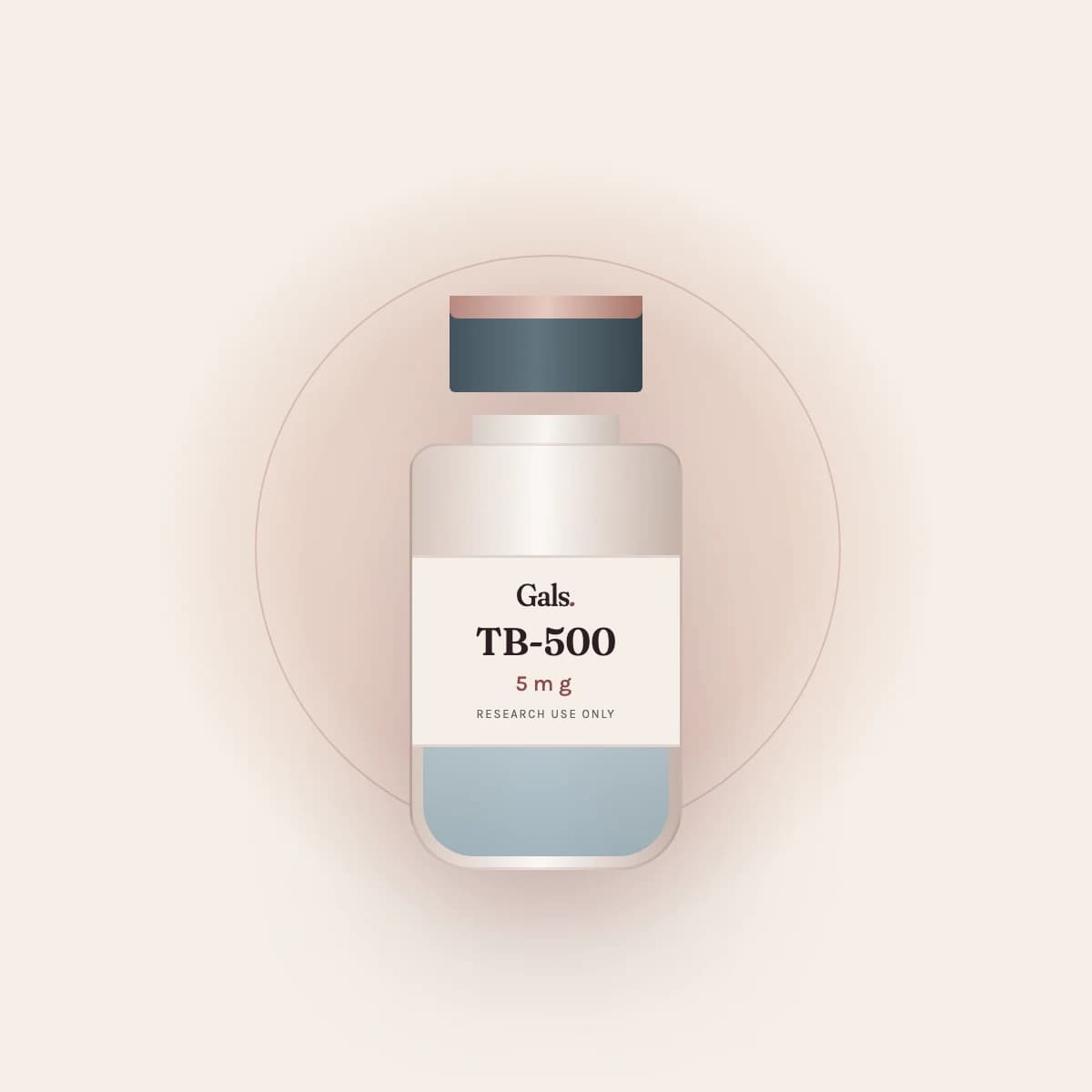
HPLC 99.02%
TB-500
4.7(19 reviews)Research-grade · For in-vitro research use only
99.02%HPLC
purity
purity
In stockOrder before 12pm AEST for same-day dispatch
Bundle & save— save up to 30%
1
Pay by bank transfer or PayID · we never see or store your banking login
All prices in AUD, inclusive of GST. Shipping calculated at checkout — free express on orders over $300.
- Third-party COA — Independent HPLC + LC-MS for this product
- Express dispatch in 24h — Tracked express post from our Australian facility
- Protective packaging — Plain, protective outer packaging on every order
- Free express shipping — On orders over $300
1
A synthetic fragment peptide used in laboratory research. Supplied as a lyophilised powder for in-vitro research use only, with a published third-party Certificate of Analysis.
Actin-signalling & fragment-peptide research
TB-500 is a short synthetic peptide corresponding to a fragment of thymosin β4, a 43-residue actin-sequestering protein found in most mammalian cell types. The fragment contains the region carrying the conserved actin-binding motif that gives the parent protein its function, which is why it is used as a minimal structural proxy for thymosin β4 in binding and migration assays. It is important not to conflate the two: TB-500 is the fragment, not the full-length protein, and the literature reports differing behaviour between them in several experimental systems.
Thymosin β4 itself was identified in thymic extracts in the mid-1960s and later reclassified once its principal biochemical role — sequestering monomeric G-actin and thereby buffering the pool available for filament assembly — was characterised. Interest in a short synthetic fragment followed from that work: if the actin-binding activity localises to a defined motif, a synthesisable fragment becomes a far more tractable reagent than a recombinant 43-residue protein. TB-500 is the product of that logic, and much of the comparative literature is explicitly about how far the fragment reproduces the parent.
Research contexts centre on cytoskeletal dynamics. The peptide appears in in-vitro studies of G-actin sequestration and actin polymerisation kinetics, in endothelial and epithelial cell-migration and wound-closure assays, and in angiogenesis models where endothelial tube formation is the readout. Work in animal models of cardiac and corneal injury also appears in the literature, alongside investigation of downstream pathways including integrin-linked kinase and Akt signalling. Reported observations in all of these belong to the primary studies concerned and are not presented here as demonstrated effects or uses.
For a fragment peptide, analytical characterisation answers a question that goes beyond simple purity: whether the material actually is the intended fragment. Sequence-adjacent fragments of a common parent protein are difficult to distinguish by eye and easy to substitute, so mass-spectrometric identity confirmation of the exact molecular mass is the decisive datum, with HPLC establishing purity and resolving deletion sequences from synthesis. Because the whole rationale for using the fragment rests on it carrying the correct binding motif intact, batch-level identity data is what makes an actin-binding result interpretable at all.
Within this catalogue, TB-500 contrasts most directly with BPC-157. Both recur in tissue-model research and are often discussed together, but structurally they share nothing: TB-500 derives from a characterised endogenous protein with a known biochemical mechanism, while BPC-157 is a synthetic sequence whose mechanism remains a subject of investigation. Comparisons between fragment and full-length thymosin β4 are a more meaningful axis of study than comparisons across unrelated peptide classes.
Research areas TB-500 is studied in
- G-actin sequestration and actin-polymerisation kinetics in vitro
- Endothelial and epithelial cell-migration and wound-closure assays
- Angiogenesis research models, including endothelial tube-formation readouts
- Downstream pathway investigation including integrin-linked kinase and Akt signalling
- Comparative characterisation of the synthetic fragment against full-length thymosin β4
- Cardiac and corneal tissue-injury research models described in the primary literature
Handling and reconstitution
Supplied as a lyophilised powder; the peptide is hydrophilic and dissolves readily in bacteriostatic or sterile water without organic co-solvent. Add the diluent slowly against the vial wall and swirl gently — short unstructured peptides are prone to foaming and to adsorption onto glass and plastic surfaces, which can reduce the effective concentration in dilute working solutions. Store the lyophilised cake sealed at -20°C protected from light and moisture, keep reconstituted solution refrigerated, and minimise freeze–thaw cycling of aliquots.
Product highlights
- Purity
- ≥ 99% (HPLC)
- Appearance
- White to off-white lyophilised powder
- Solubility
- Soluble in bacteriostatic / sterile water
- Testing
- Independent third-party HPLC + LC-MS
- Storage
- Store lyophilised at -20°C, protected from light
- Intended use
- In-vitro laboratory research only
Read the TB-500 research overview →
For laboratory research use only. Not for human or veterinary use, consumption, or therapeutic application.
Questions
TB-500 — frequently asked questions
What is TB-500?
TB-500 is a short synthetic peptide (CAS 77591-33-4) corresponding to a fragment of thymosin β4, a 43-residue actin-sequestering protein found in most mammalian cell types. The fragment carries the conserved actin-binding motif, which is why it is used as a minimal structural proxy for the parent protein in binding and migration assays. Supplied lyophilised for in-vitro research use only.
Is TB-500 legal in Australia?
TB-500 is not an approved therapeutic good in Australia and is not on the Australian Register of Therapeutic Goods. It is supplied as a laboratory research chemical for in-vitro use, not for human or veterinary use. Nothing here is legal advice — researchers must confirm their intended laboratory use complies with the rules that apply to them.
Is TB-500 the same as thymosin β4?
No. TB-500 is a synthetic fragment; thymosin β4 is the full-length 43-residue protein. Much of the comparative literature is explicitly about how far the fragment reproduces the parent, and differing behaviour between the two is reported in several experimental systems, so they should not be treated as interchangeable in an experimental design.
What is TB-500 studied in relation to?
Before you order
Research guides for TB-500
Background reading for researchers — what this compound is, how it is positioned, and how to verify what is in the vial.
Compound profileTB-500 research monographStructure, CAS, sequence, purity and the research areas TB-500 is studied in.View profile →Compound guide
TB-500 in Australia: A Research Overview
What TB-500 is, why it is studied in laboratory research, and what to look for when sourcing it in Australia.
Read →Compound guideBPC-157 vs TB-500: A Research Compound Comparison
How BPC-157 and TB-500 differ as research compounds — by structure, molecular targets, and how each is investigated in the laboratory.
Read →HandlingHow to Read a Peptide Certificate of Analysis (COA)
A short guide to what a Certificate of Analysis actually tells you — and what to check before you trust a vial.
Read →